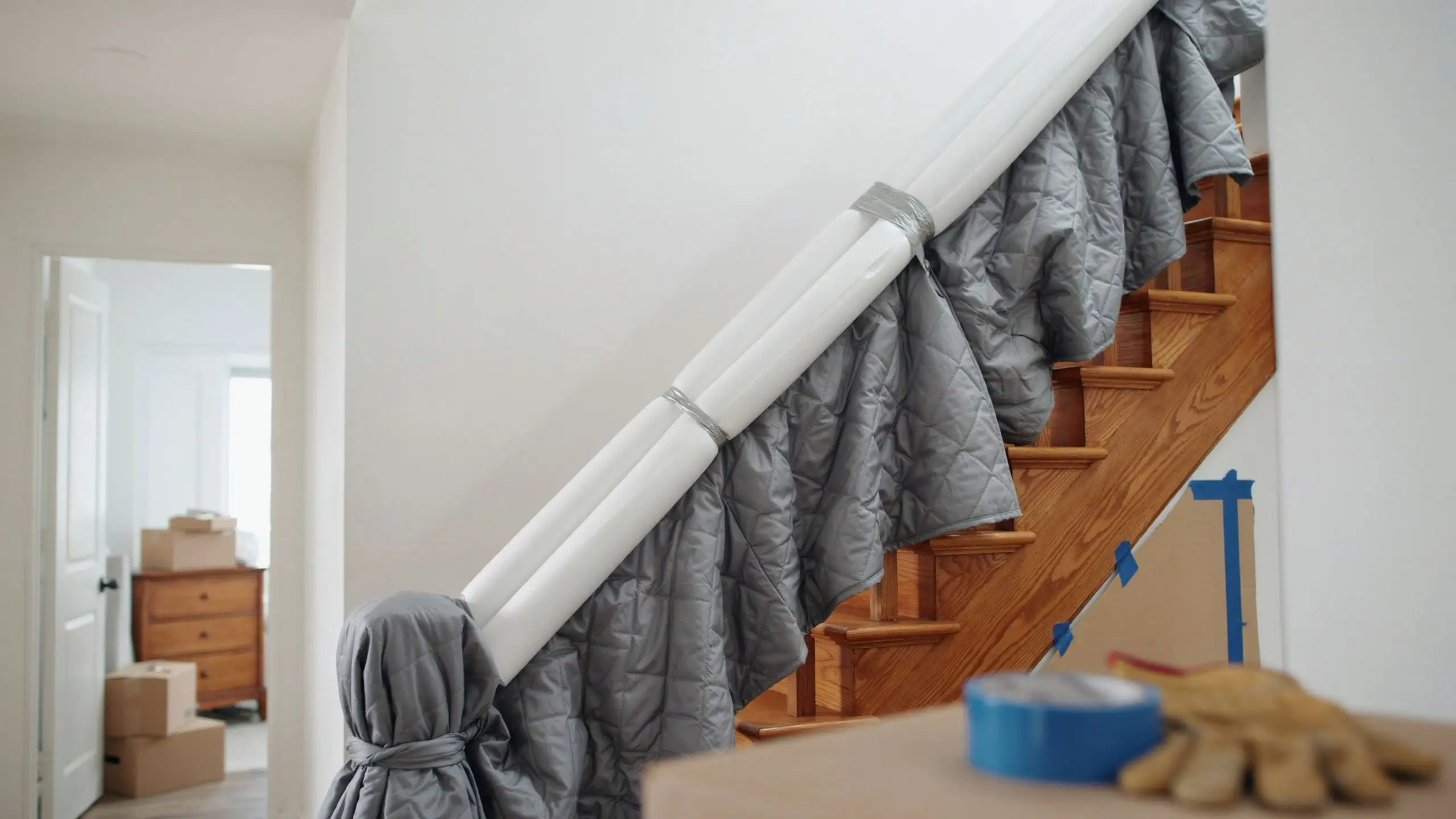
How to protect stair railings during a move? wrap the handrails, balusters, and newel posts securely using moving blankets or split foam pipe insulation. Tighten the padding with stretch wrap or painters tape, ensuring adhesives only touch the padding never the delicate wood finish and keep everything tucked away from the steps to eliminate tripping hazards.
Before lifting anything, measure the narrowest points and tight turns of the staircase to map out your path. Pay extra attention to the highly vulnerable newel posts at the top and bottom of the stairs where impacts are most common. Planning these tight angles in advance keeps both your furniture and your woodwork entirely free of damage.
Why Railings Take the Hit
A staircase is a narrow tunnel with a railing running along it at hip height. That’s exactly where a dresser corner, a box, or your own elbow travels.
Most damage isn’t carelessness. It’s geometry. Someone pivots at a landing, the far end of a sofa swings wide, and a thin baluster snaps or a finish gets gouged. Once you see it that way, the fix is obvious: pad the places the load will swing into.
Where the Damage Usually Happens
Walk your staircase and look for these spots before you buy anything.
- The turn or landing, where long items swing wide
- The bottom newel post, which gets clipped as an item comes off the last step
- Balusters at waist height, which are thin and sometimes only pinned or glued
- Handrail ends and wall brackets, if your rail mounts to the wall
- The top of the stairs, where people step onto the landing with elbows out
What You’ll Need
Nothing fancy. Slit foam pipe insulation (the tube type from a hardware store), moving blankets, flattened cardboard, painter’s tape, and stretch wrap for securing padding to itself. Buy the foam tube to fit your handrail, and check that it snaps on before moving day.
How to Cover Stair Railings for Moving
- Photograph the railing from a few angles, then give each baluster a gentle wiggle. If something is already loose or chipped, you want a record of it.
- Measure the narrowest point of the staircase and compare it with your biggest item. Padding eats into that gap.
- Slice the foam tube lengthwise if it isn’t already, and snap it over the handrail. Secure it by taping the foam to itself or wrapping stretch wrap around the foam only.
- Keep tape off the finished wood. Adhesive can lift worn varnish or paint, so if you must tape to the rail, test a hidden spot first and check how the manufacturer recommends removing it.
- Wrap the newel post in a moving blanket and fasten the blanket to itself.
- For open staircases, drape a blanket over the handrail so it hangs across the balusters, with the foam tube holding it at the top.
- Pad the wall side too. A railing isn’t the only thing in the way.
- After the first trip up or down, check everything. Padding slips more often than people expect.
How to Protect Handrails When Moving Furniture
The padding helps, but how you carry matters just as much.
Take off what comes off: legs, drawers, doors, cushions. A smaller object turns tighter. Put a spotter at the turn whose only job is to watch the railing, not the item. Call out the pivot before it happens.
And never use the railing as a pivot or lever, or as something to haul weight against. It’s built to be held, not to take a load from the side.
How to Prevent Damage to Stair Railings During a Move
Some of this is preparation, not padding.
- Clear the stairs of everything else first. Boxes left on steps make people twist to avoid them, and twisting is when corners swing.
- Move the biggest, awkward pieces first while everyone is fresh.
- Pack lighter items into boxes you can carry with a straight body, not hugged out to the side.
- If a piece clearly won’t clear the turn, stop and rethink it. Forcing it is how balusters snap.
Should You Take the Railing Off?
Usually, no. Handrails are a safety feature, and many places have rules about them, so removing one and putting it back poorly can leave you with a loose or non-compliant railing. Local requirements vary, so verify them with your city or your landlord before touching anything. If the only way to get an item up the stairs is to remove the rail, that’s a sign to bring in professionals or use a different route, like a window or balcony.
Mistakes That Cause the Damage
- Padding so thick that the furniture jams against it
- Putting tape directly on the finish
- Covering the handrail but forgetting the balusters and the newel post
- Setting the padding once and never rechecking it
- Hanging on the railing to steady yourself under a heavy load
If You’re Renting or Selling
Take the “before” photos even if you think they’re unnecessary. A scuff on a railing can be argued about later if you can’t show it wasn’t there. And if you’re selling, final walkthroughs are when little marks on stairs get noticed.
When It’s Time to Hire Help
Some staircases are simply a bad fit for DIY: steep, tight, or turning twice. Add a heavy piece like a sofa or a wardrobe and the risk goes up quickly. Chamomile Go is a family-owned moving company in Sherman Oaks with over 16 years in the business, and one thing worth asking any mover, us included, is what exactly they’ll pad before moving day. If you’d rather not squeeze a sectional around a landing yourself, take a look at our local moving services in Los Angeles.
Planning a Move Around Stairs?
Stairs, tight turns and heavy furniture are where a move gets harder, and where having the right crew pays off. Contact Chamomile Go handles moves across Los Angeles with care for your home as well as your belongings.
FAQs
What’s the cheapest way to protect handrails when moving?
Slit foam pipe insulation or pool noodles cut lengthwise, plus moving blankets you may already own. Cardboard works for flat areas.
Does painter’s tape damage stair railings?
It can, especially on old, worn or freshly painted finishes. Test a hidden spot, or tape only to the padding.
Is bubble wrap enough?
For light jobs, it’s fine. For furniture that’s heavy, foam and blankets absorb a hit better.
Can I protect metal or wrought iron railings the same way?
Yes, but the risk there is chipped paint rather than dents. Padding works the same way, but check that it can’t slide.